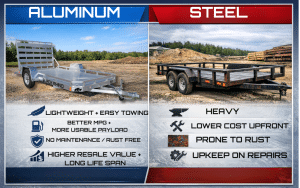
 Black Rhino Trailers comparison: aluminum vs steel—weight, towing, maintenance, and long-term value.
Chris-Style Summary (Aluminum vs. Steel Weight and Flex)
Aluminum vs steel trailer – A lot of people assume aluminum trailers are always lighter than steel. That is not always true.
In real-world trailer design, weight depends on the entire build, not just the material. A well-built aluminum trailer can weigh about the same as a steel trailer—and in some areas, even more—depending on the frame design, wall thickness, crossmember count, deck structure, axle package, and intended load rating.
Here’s why: aluminum and steel do not perform the same structurally. To reach the same strength and stiffness goals, an aluminum trailer may need larger sections, thicker material, more crossmembers, or added bracing. That extra structure adds weight.
So the correct comparison is not just aluminum vs. steel. The real comparison is one complete trailer design vs. another complete trailer design.
The same goes for “flexibility.” Steel is stiffer as a material, while aluminum is less stiff in equal-size sections. That means aluminum trailer designs often need different geometry and support to control flex. Depending on how the trailer is built, this can change how rigid the frame feels and how the trailer behaves under load on the road.
Bottom line:
Aluminum trailers are often lighter, but not automatically lighter. We match trailers by actual use and actual specs—empty weight, payload capacity, frame design, axle package, and how the trailer will be used—not just by the word “aluminum.”
We are the 411-Trailers Group – Shop Black Rhino Today