At Black Rhino Trailers (BR), welding wire isn’t a commodity. Instead, BR treats filler wire as part of the structure. Because of that, the filler choice influences arc stability, bead quality, and long-term joint durability.
Aluminum makes an excellent trailer material because it’s lightweight and corrosion resistant. However, aluminum also reacts quickly to heat. As a result, the metal can move or distort when the weld process drifts. That’s why BR starts with premium aluminum filler wire and focuses on three real-world outcomes:
- Arc stability — a smooth, controllable weld
- Consistent penetration — repeatable joint strength
- Corrosion resistance — better long-term durability
In simple terms, the right wire plus a disciplined process produces cleaner welds, less rework, and a straighter, more durable frame.
Why Aluminum Welding Wire Matters on a Trailer
Compared with steel, aluminum conducts heat faster and expands more. At the same time, aluminum forms an oxide layer almost immediately. Because of that, BR keeps preparation tight and settings consistent.
So, when people ask, “What’s the best aluminum welding wire?” BR gives a practical answer:
BR matches the filler wire to the base alloy, the joint design, and the job your trailer must do.
A trailer frame isn’t decorative welding. Instead, it’s structural welding. Therefore, BR prioritizes control and repeatability because repeatability produces consistent results.
What BR Looks for in Aluminum Filler Wire
1) A Stable Arc — Control
A stable arc lets the welder hold the puddle exactly where it belongs. More importantly, aluminum can swing from “not quite hot” to “too hot” very quickly.
When the arc stays stable, the welder can maintain a steady rhythm. As a result, BR looks for:
- Smoother bead profile
- Fewer stops and restarts
- Less cleanup
- Fewer defects that require grinding or rewelding
2) Consistent Penetration — Repeatable Strength
BR doesn’t chase penetration by simply overheating the joint. Instead, the goal is proper fusion across the joint with a process that can be repeated consistently.
Repeatability matters because trailer frames experience vibration, road shock, twisting forces, and changing loads throughout their service life.
3) Corrosion Resistance — Real-World Durability
Trailers live in rain, road spray, humidity, salt air, and changing weather.
Because of that, BR considers corrosion resistance part of the overall build process, especially for trailers used near the coast or regularly exposed to wet environments.
American-Built Workmanship You Can See
At 411-Trailers, we believe customers should be able to see the construction details behind the claims.
We sell trailers that we can inspect, use, and explain. That gives us the opportunity to look beyond a brochure and show customers how the trailer is actually put together.
A close-up of a Black Rhino aluminum frame shows the actual joint construction, reinforcement points, aluminum uprights, and visible weld beads joining the structural components.
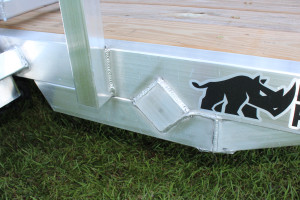 Close-up of a Black Rhino aluminum trailer frame showing the welded joint and reinforcement detail used in the trailer’s construction.
These details matter.
A photograph cannot replace engineering specifications, proper welding procedures, or structural testing. However, it can help a buyer see the workmanship that goes into the trailer rather than relying only on terms such as “heavy duty.”
As an American company, we are proud to represent American-built products that we know and use ourselves.
For us, that means being able to point to a trailer and explain:
- How the frame is assembled
- Where reinforcement is added
- How the aluminum members are joined
- How the welds are positioned
- Why certain construction details matter in everyday use
We would rather show customers the actual construction than simply tell them a trailer is well built.
That is an important part of how we evaluate the products we sell.
Common Aluminum Filler Wires — and Why the Choice Matters
People often compare filler alloys such as 4043 and 5356. In fact, both can work well. However, each supports different priorities.
Accordingly, BR chooses filler wire based on the base material, joint design, welding procedure, and performance requirements.
Aluminum-Silicon Fillers — Often Discussed With 4043
This filler family is commonly considered when the application calls for characteristics such as:
- Smooth bead appearance
- Good puddle flow
- Reduced sensitivity to certain welding conditions
Aluminum-Magnesium Fillers — Often Discussed With 5356
This filler family is commonly considered when the application calls for characteristics such as:
- Structural performance
- Corrosion resistance in many environments
- Weld characteristics suitable for service loads
Importantly, BR doesn’t force a one-size-fits-all answer.
Instead, filler-wire selection is treated as part of the overall welding and design process.
“Aerospace-Grade” Welding Talk — What We Mean and What We Don’t
You may hear phrases such as “NASA wire” or “aerospace-grade.”
To be clear, BR does not claim NASA endorsement or certification.
Instead, the useful comparison is the process mindset: control the material, control the procedure, prepare the joint correctly, and work toward consistent results.
Aerospace welding practices place strong emphasis on repeatability, process control, material selection, and joint integrity.
Similarly, BR applies a process-first approach to aluminum trailer construction.
In short, the focus is on what matters:
- Correct material selection
- Proper preparation
- Controlled welding procedures
- Consistent execution
Bottom Line: Better Wire + the Right Procedure = a Better Frame
A trailer frame isn’t just “welded together.”
In the end, the frame is the result of material selection, joint design, preparation, welding procedure, and execution.
The filler wire plays an important role in that system.
When BR combines properly selected filler wire with a disciplined welding process, the goal is practical long-term benefit:
- Cleaner, more consistent welds
- Controlled heat input
- Reduced distortion
- Less rework
- Consistent structural joints
- A frame built for long service life
So, if you’re comparing aluminum trailers, don’t just ask:
“What alloy is it?”
Also ask:
“How is the trailer built, and how does the manufacturer control the welding process?”
The answer can tell you much more about the finished trailer.
FAQ
Do You Use “NASA Aluminum Welding Wire”?
BR uses premium aluminum filler wire because filler selection affects weld behavior, joint performance, and corrosion resistance.
The reference to aerospace practices is about the process mindset — careful material selection, preparation, repeatability, and welding control.
BR does not claim NASA endorsement or certification.
Why Does Aluminum Need Special Filler Wire?
Aluminum transfers heat quickly and expands as temperature changes.
As a result, filler selection must be compatible with the base material and the intended joint.
The wrong material or an uncontrolled process can contribute to inconsistent bead shape, distortion, or reduced weld quality.
Therefore, BR considers filler selection together with the base alloy, joint design, preparation, and welding procedure.
Does Filler Wire Really Change the Strength of the Trailer?
Filler wire is one part of the welding system.
Weld performance also depends on:
- Joint design
- Material preparation
- Cleanliness
- Fit-up
- Heat control
- Welder technique
- Welding-machine settings
Because of that, BR does not treat filler wire as a stand-alone answer.
The complete system matters: correct material + proper preparation + controlled process + consistent execution.
What Does This Mean for Me as an Owner?
Ultimately, it means the trailer frame is built using a disciplined approach to aluminum fabrication.
For the owner, the goal is straightforward: consistent construction, durable structural joints, corrosion-resistant materials, and a trailer designed for long-term service.
At 411-Trailers, we also believe there is value in being able to show you those construction details firsthand.
We sell American-built trailers that we can inspect, use, and explain — so you can better understand what you are buying.